
Capacity, Market Position & the Economics of Gold Refining
India is one of the world’s most important gold markets, and behind the country’s jewellery industry is a rapidly evolving refining ecosystem. Gold refineries convert imported doré and recycled jewellery scrap into high-purity bullion, bars and minted products that ultimately enter the jewellery, investment and bullion markets.
In 2026, India’s organised gold-refining industry remains strategically important despite significant challenges from high gold prices, import economics, recycling flows and changing bullion-market regulations.
This article looks at 10 important and active gold-refining companies/refining groups associated with India’s organised refining ecosystem, using publicly available capacity information and current industry evidence.
Important: This is not an official Government of India ranking. “Top 10” here means major/important refiners identified through publicly available industry and company information. Installed capacity is not the same as actual gold refined in a year.
India’s Gold Refining Industry in 2026
India’s formal gold-refining industry has expanded dramatically over the last decade.
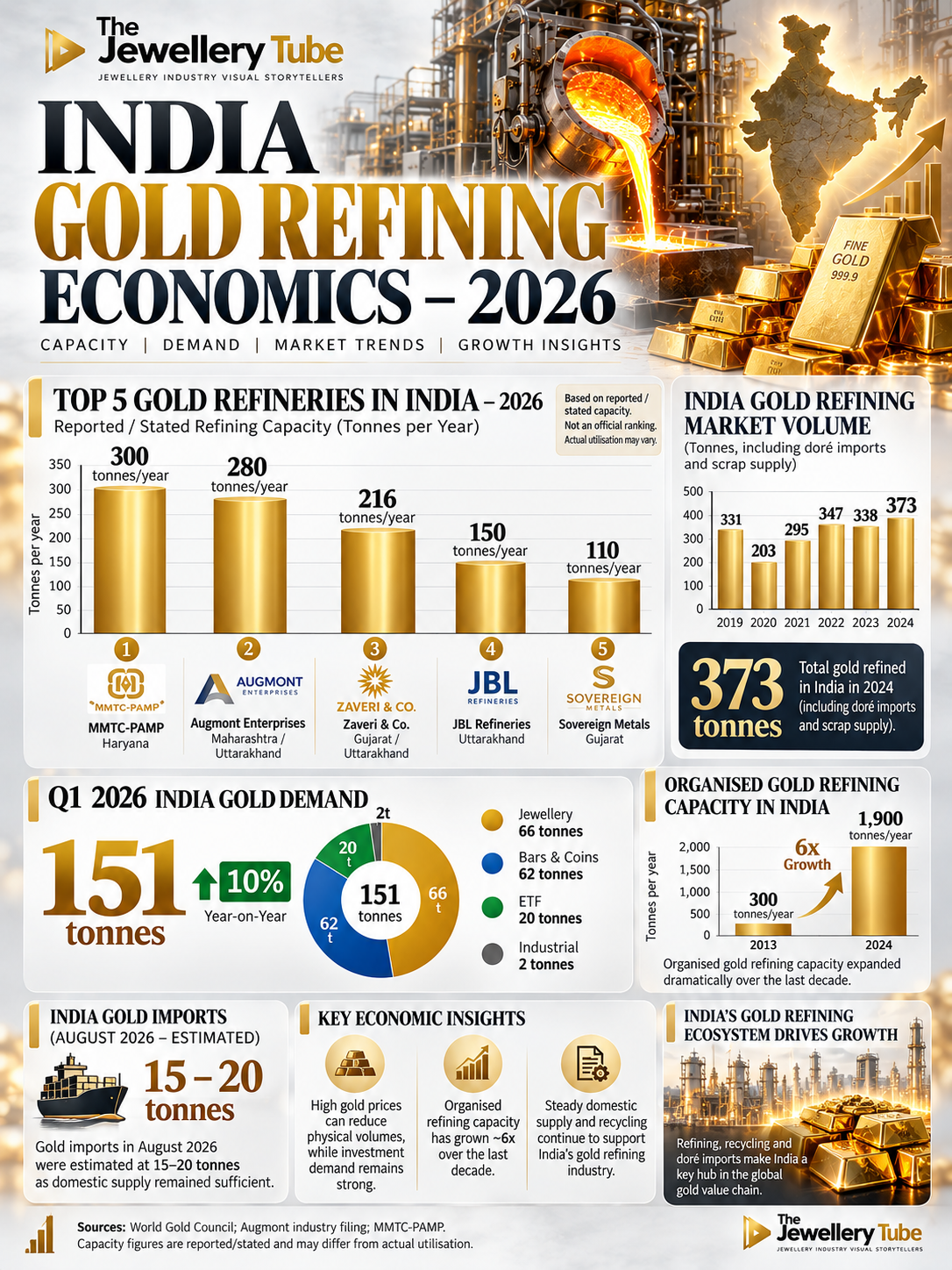
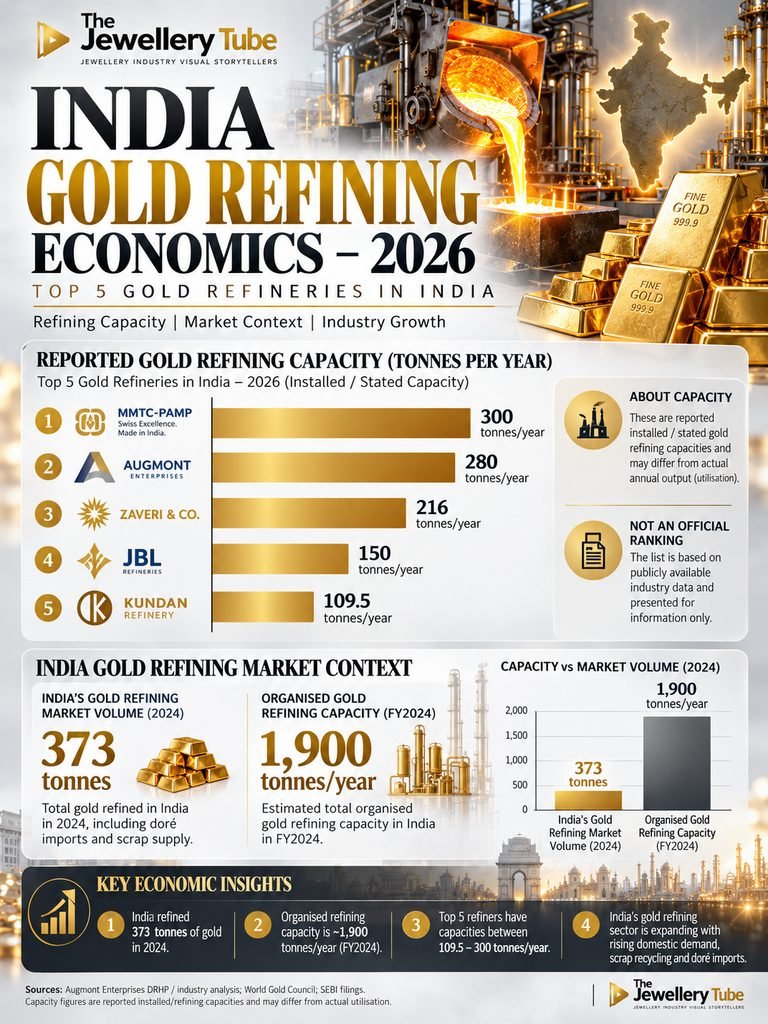
According to industry research cited in an Augmont Enterprises filing, India had 57 BIS-accredited gold refineries as of September 2024, compared with 33 in 2022. The same source estimates India’s 2024 refining market at 373 tonnes, including 258 tonnes from imported doré and the balance from scrap supply.
Organised refining capacity has also grown substantially. World Gold Council research shows capacity rising from around 300 tonnes per year in 2013 to about 1,800 tonnes in 2021, while industry filings estimate approximately 1,900 tonnes per year in FY2024.
This creates an interesting economic situation: India has built substantial refining capacity, but the actual quantity of gold available for refining can fluctuate significantly depending on doré imports, recycled gold and the economics of legal imports.
Top 10 Gold Refining Companies / Refiners in India – 2026
1. MMTC-PAMP
Location: Haryana
Reported refining capacity: Approximately 300 tonnes of gold per year
MMTC-PAMP is one of the most prominent names in India’s organised precious-metals industry. The company states that it has an installed capacity of 300 tonnes of gold and 600 tonnes of silver per year.
The company also describes itself as India’s largest gold refiner and says its refinery is LBMA accredited. Its operations cover refining, bullion, minted products and other precious-metal services.
MMTC-PAMP’s scale makes it a significant part of India’s formal bullion supply chain.
2. Augmont Enterprises
Locations: Maharashtra and Uttarakhand
Current installed capacity: Approximately 284 tonnes per year across two facilities
Augmont has become one of India’s important integrated precious-metals businesses.
Current company information reported for March 2026 indicates that Augmont operated two gold and silver refining facilities, with installed capacities of approximately 144 tonnes per year at Rudrapur and 140 tonnes per year at Mumbai.
Interestingly, actual gold refining volumes are much lower than installed capacity. Augmont reportedly refined 13.34 tonnes of gold in FY2026, compared with 15.08 tonnes in FY2025.
This illustrates an important point when comparing refineries: capacity does not equal utilisation.
Augmont was also added to additional MCX Good Delivery categories in July 2026, expanding the range of its gold products eligible for exchange delivery.
3. Zaveri & Co.
Headquarters: Ahmedabad, Gujarat
Reported refining capacity: Approximately 216 tonnes per year
Zaveri & Co. is part of the Zaveri Group, a long-established Indian bullion and jewellery business.
The group operates across bullion, gold refining, jewellery manufacturing and retailing. Public industry information has reported refining capacity of approximately 216 tonnes per year.
Zaveri & Co. also became part of the expanded MCX Good Delivery framework in 2026, with its eligible gold products listed for exchange delivery.
The company’s Ahmedabad presence is particularly relevant to Gujarat’s large jewellery and bullion ecosystem.
4. JBL Refineries
Location: Uttarakhand
Reported capacity: Approximately 150 tonnes per year
JBL Refineries is one of the larger names in India’s organised refining sector.
Industry data cited in SEBI filings lists JBL with approximately 150 tonnes per year of refining capacity.
Uttarakhand has historically attracted significant refining investment because of the state’s industrial infrastructure and the policy environment that supported the growth of India’s organised refining sector.
5. CGR Metalloys
Location: Kerala
Reported capacity: Approximately 150 tonnes per year
CGR Metalloys has been operating in precious-metals processing since the 1990s.
The company describes itself as having established an integrated precious-metals refinery and provides refining, assaying, hallmarking, minting and bullion-related services.
Its current website states that the refinery processes various gold-bearing alloys and scrap and uses sophisticated recovery processes to maximise precious-metal recovery.
CGR is also identified as an active gold refiner in 2026 Responsible Minerals Initiative-related disclosures.
6. Sovereign Metals
Location: Gujarat
Reported capacity: Approximately 110 tonnes per year
Sovereign Metals is an important Gujarat-based precious-metals refiner.
Industry research identifies approximately 110 tonnes per year of refining capacity.
The company has also been part of India’s exchange-linked bullion ecosystem. In 2026, Sovereign Metals remained included in the MCX Good Delivery framework for eligible gold products.
Gujarat’s importance as a jewellery manufacturing, diamond and bullion centre gives refiners operating in the state access to a large downstream precious-metals ecosystem.
7. M.D. Overseas
Locations: Uttarakhand and Rajasthan
Reported capacity: Approximately 109.5 tonnes per year
M.D. Overseas is another important participant in India’s organised bullion-refining sector.
Industry filings report approximately 109.5 tonnes per year of refining capacity.
M.D. Overseas is also part of the MCX Good Delivery ecosystem. In 2026, the exchange framework included its gold products in eligible delivery categories.
This exchange eligibility is significant because Good Delivery status can improve a refinery’s access to organised bullion-market infrastructure.
8. Kundan Refinery
Locations: Haryana / Uttarakhand
Reported capacity: Approximately 109.5 tonnes per year
Kundan is another established name in India’s precious-metals industry.
Industry research has reported approximately 109.5 tonnes per year of refining capacity.
Kundan’s gold products are also included in the MCX Good Delivery framework. In 2026, its eligible products included 1 kg gold bars and smaller gold products.
Kundan’s position illustrates how India’s refining industry is increasingly connected to organised bullion exchanges, retail investment and jewellery manufacturing.
9. Narondas Manordas
Location: Maharashtra
Reported capacity: Approximately 100 tonnes per year
Narondas Manordas is one of the established names in India’s precious-metals refining landscape.
Historical industry data cited by the World Gold Council and subsequent industry filings place its refining capacity at around 100 tonnes per year.
Although its reported capacity is below the largest Indian refiners, its inclusion in the industry’s major-refiner lists reflects the broader development of organised refining outside the largest national players.
10. Emerald Jewel Industry India
Location: Tamil Nadu
Gold capacity: Approximately 40 tonnes per year
Emerald Jewel Industry India is particularly interesting because it combines large-scale jewellery manufacturing with precious-metals processing.
The company’s current infrastructure information states an installed capacity of 40 tonnes of gold per year, alongside substantial diamond, platinum and silver capabilities.
Emerald is also an active contemporary industrial operation: Responsible Jewellery Council certification information shows a current certification period beginning in May 2026, while 2026 credit-rating information reports improved operational and financial performance for FY2026.
The company therefore demonstrates the increasingly integrated nature of India’s jewellery manufacturing and precious-metals ecosystem.
India Gold Refining Capacity – The Bigger Picture
The development of India’s refining industry has been dramatic.
| Period | Organised refining capacity |
|---|---|
| 2013 | ~300 tonnes/year |
| 2021 | ~1,800 tonnes/year |
| FY2024 | ~1,900 tonnes/year estimated |
Industry research indicates that organised capacity increased by roughly six times between 2013 and FY2024.
However, the refining market itself is considerably smaller than total installed capacity. In 2024, approximately 373 tonnes of gold entered the identified refining market, including doré and scrap supply.
This difference between installed capacity and actual available feedstock is one of the most important economic stories in India’s refining industry.
What Does a Gold Refinery Actually Do?
Gold refineries process gold-bearing material and recover high-purity precious metal.
The two major sources of feedstock in India are:
1. Imported Gold Doré
Doré is semi-refined gold, generally produced at mining operations before being sent to specialist refineries.
Indian refiners can process imported doré into high-purity bullion suitable for the domestic market.
2. Recycled Gold
Old jewellery, manufacturing scrap and other gold-bearing materials can be recovered and refined.
Recycling becomes particularly important when gold prices rise because consumers may become more willing to sell or exchange old jewellery.
The World Gold Council has highlighted the growth of organised recycling and the importance of exchange-eligible recycled gold in strengthening India’s formal refining ecosystem.
Why Refining Capacity Does Not Mean Refining Output
This is an important point for investors, jewellery businesses and industry observers.
A refinery with 300 tonnes of annual capacity does not necessarily refine 300 tonnes in a year.
Actual output depends on:
- Availability of doré
- Domestic scrap supply
- Gold prices
- Import duties
- Working capital
- Refining margins
- Customer demand
- Bullion-market conditions
- Exchange and regulatory requirements
Augmont provides a useful illustration: its reported installed capacity was far higher than its actual FY2026 gold refining volume of 13.34 tonnes.
Therefore, comparing refineries only by installed capacity can give an incomplete picture of their economics.
2026: The Economic Challenges Facing Indian Gold Refiners
India’s gold-refining industry entered 2026 with considerable installed capacity, but the economics of bringing gold into the formal supply chain remained challenging.
Reuters reported in June 2026 that a significant increase in India’s gold import tariff had created pressure on legal gold imports and refinery economics, while also reporting concerns about renewed smuggling. These developments illustrate how tax and import-policy changes can directly affect the formal refining sector.
For refiners, the key economic equation is therefore not simply:
More refinery capacity = more gold refined.
Instead:
Gold supply + import economics + recycling + refining margins + bullion demand = refinery utilisation.
The Role of MCX and Good Delivery
Exchange eligibility is increasingly important for Indian refiners.
In July 2026, MCX expanded its Good Delivery framework to include additional domestic refiners and products. The framework included refiners such as M.D. Overseas, Kundan Refinery, Zaveri & Company, Augmont, Titan, Parker Precious Metals and Sovereign Metals.
Good Delivery status can help connect refiners with organised exchange-based bullion markets and improve the infrastructure available for physical delivery.
India’s Gold Refining Industry: From Capacity to Scale
India’s gold-refining story has changed significantly since 2013.
The country moved from a relatively small number of formal refineries to a much larger organised refining ecosystem. World Gold Council research recorded the number of formal operations rising from fewer than five in 2013 to 33 by 2021. More recent industry filings indicate 57 BIS-accredited refineries by September 2024.
The next phase of the industry is likely to focus less simply on building capacity and more on:
- Increasing refinery utilisation
- Expanding organised gold recycling
- Improving doré supply
- Strengthening bullion-market infrastructure
- Increasing exchange participation
- Improving traceability
- Expanding high-purity bullion and minted products
- Integrating refining with jewellery manufacturing
Top 10 Gold Refiners in India 2026 — Quick Reference
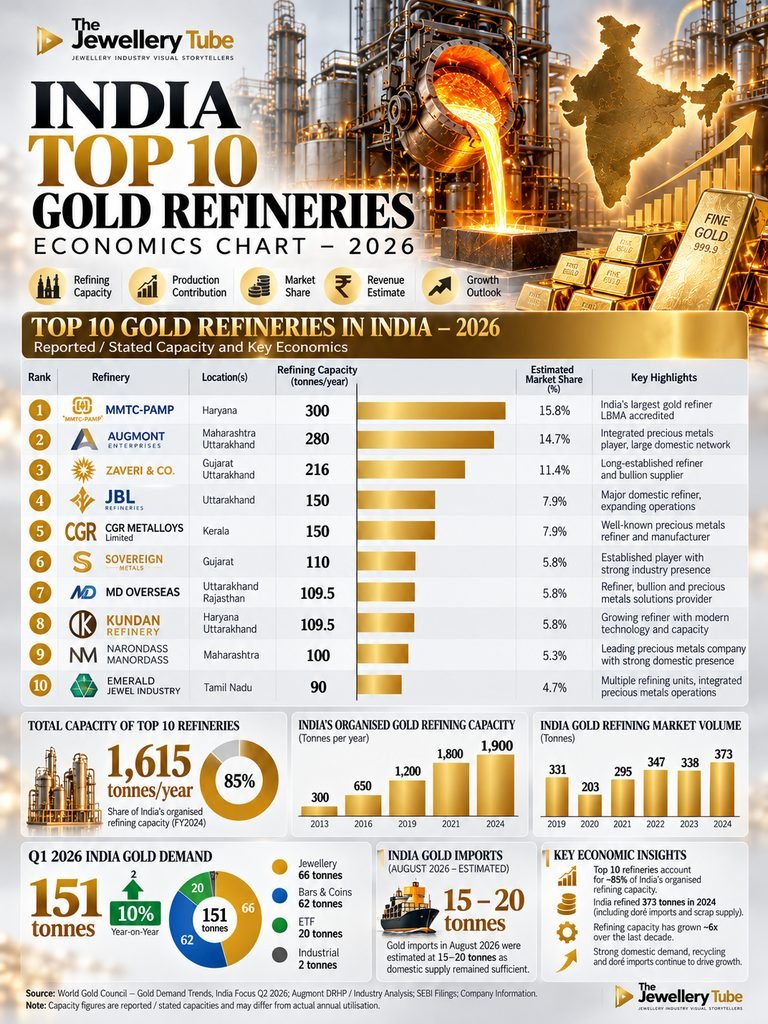
| Refinery | Reported / stated capacity |
|---|---|
| MMTC-PAMP | ~300 t/year |
| Augmont Enterprises | ~284 t/year current installed capacity* |
| Zaveri & Co. | ~216 t/year |
| JBL Refineries | ~150 t/year |
| CGR Metalloys | ~150 t/year |
| Sovereign Metals | ~110 t/year |
| M.D. Overseas | ~109.5 t/year |
| Kundan Refinery | ~109.5 t/year |
| Narondas Manordas | ~100 t/year |
| Emerald Jewel Industry India | ~40 t/year |
*Augmont’s current two-facility installed capacity reported as of March 2026 is approximately 284 tonnes/year; older industry filings reported 280 tonnes.
Capacity figures should not be interpreted as actual annual production or a measure of profitability.
Conclusion
India’s gold-refining industry has become an essential part of the country’s jewellery and bullion economy.
Companies such as MMTC-PAMP, Augmont, Zaveri & Co., JBL Refineries, CGR Metalloys, Sovereign Metals, M.D. Overseas, Kundan, Narondas Manordas and Emerald Jewel Industry India represent different parts of this expanding ecosystem.
The headline number is impressive: organised refining capacity has grown from around 300 tonnes in 2013 to an estimated 1,900 tonnes in FY2024.
But the bigger story for 2026 is utilisation.
India has significant refining infrastructure. The industry’s future performance will depend on how effectively that capacity is supplied with gold doré and recycled gold, how import and tax policies evolve, and how refiners connect with India’s rapidly changing bullion and jewellery markets.
For India’s jewellery industry, the refinery is no longer simply a back-end processing facility. It is becoming an increasingly important link between global gold supply, recycling, bullion markets, manufacturers, retailers and the Indian consumer.
Sources
World Gold Council; SEBI filings and industry disclosures; MMTC-PAMP company information; Augmont Enterprises disclosures; MCX Good Delivery information; Responsible Jewellery Council; Emerald Jewel Industry India; Reuters reporting on 2026 gold-import economics.
The Jewellery Tube — Jewellery Industry Visual Storytellers
top 10 gold refineries in India 2026gold refineries in Indialargest gold refineries in Indiabest gold refineries in IndiaIndian gold refining companiesgold refinery capacity Indiagold refining industry India 2026gold refining companies Indiagold refinery capacitygold recycling Indiagold bullion refinery Indiagold refining market IndiaIndian gold industrygold refinery companiesMMTC PAMP refineryAugmont refineryZaveri gold refineryJBL RefineriesCGR MetalloysSovereign MetalsKundan Refinery
#GoldRefineries #GoldRefining #IndiaGold #GoldIndustry #GoldMarket #GoldRefineryIndia #GoldBullion #GoldRecycling #JewelleryIndustry #IndianJewellery #GoldEconomics #TheJewelleryTube
India Gold MarketWorld’s Top 10 Largest Gold Mines 2026Gold MiningGold RefineryJewellery Manufacturers in IndiaIndian Jewellery IndustryJewellery Retailers in IndiaHistory of Lab Grown DiamondsThe Jewellery Tube Blog



 English (United States)
  English (UK)