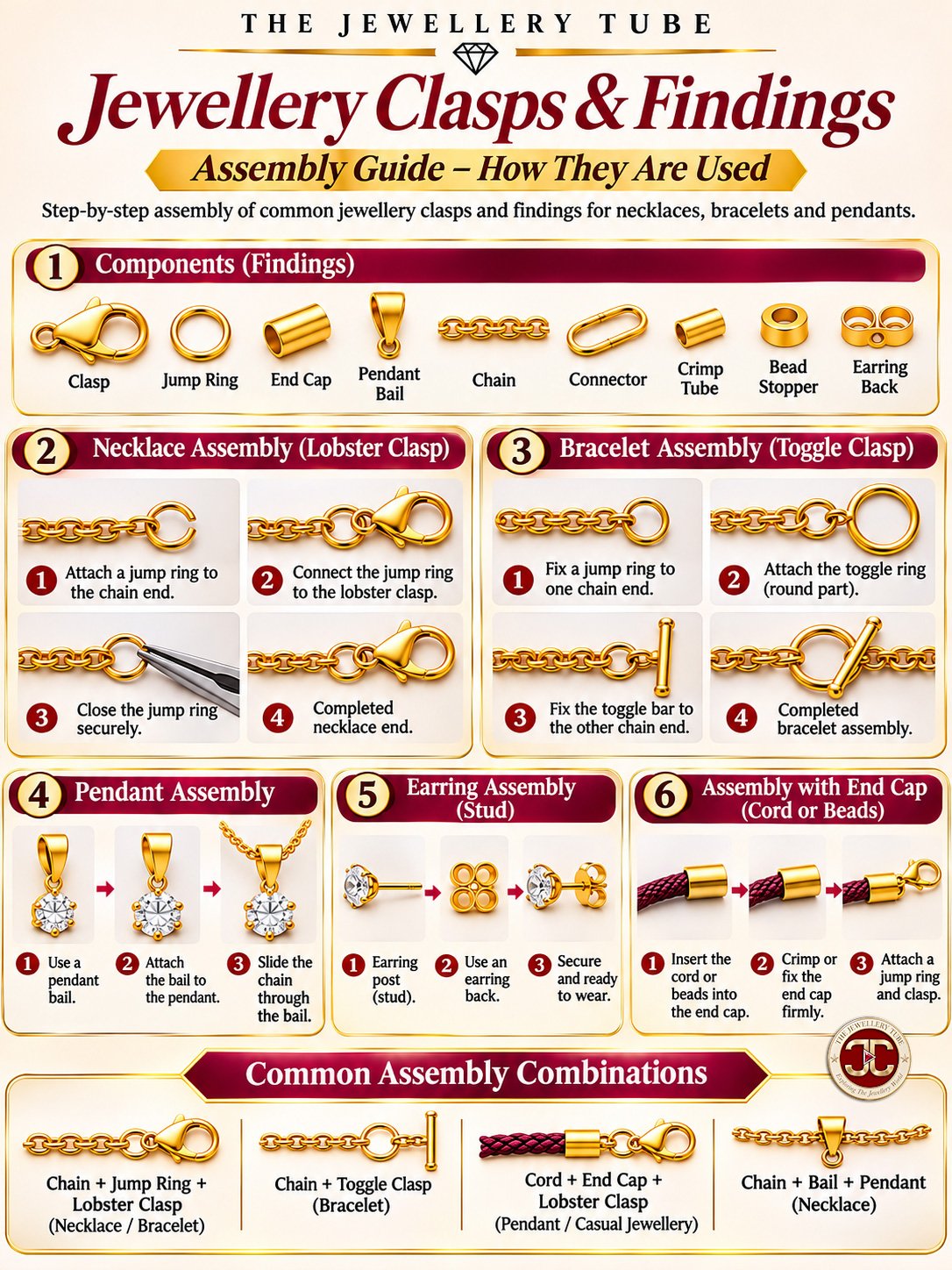
A Beginner-Friendly Guide to the Small Components That Make Jewellery Complete
When we admire a beautiful necklace, bracelet or pair of earrings, our attention usually goes to the gemstones, precious metals and overall design. But behind every well-finished jewellery piece are several small components that make it wearable, secure and functional.
These components are known as jewellery findings.
From box clasps and lobster clasps to pendant bails, earring backs and connecting pins, jewellery findings play an essential role in jewellery manufacturing and design.
In this guide, The Jewellery Tube explores 14 popular types of jewellery clasps and findings, their functions and a simple step-by-step example of necklace assembly.
1. What Are Jewellery Clasps and Findings?
Jewellery findings are the functional components used to connect, secure, assemble and finish jewellery.
They are used in:
- Necklaces and chains
- Bracelets and bangles
- Earrings
- Pendants and charms
- Beaded jewellery
- Fashion and designer jewellery
A clasp is a particular type of finding designed to fasten two ends of a jewellery piece together. Other findings, such as jump rings, bails and end caps, help connect different elements.
Although these components may be small, their design and quality can influence the security, comfort, durability and appearance of finished jewellery.
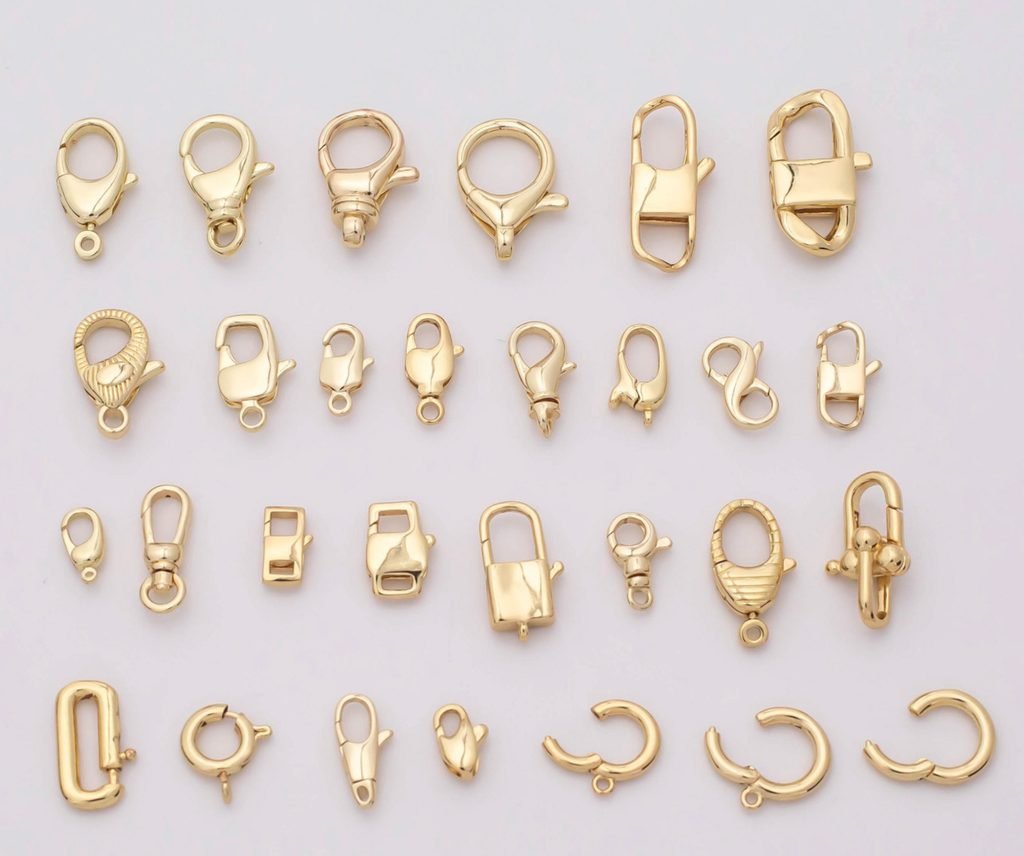
2. Fourteen Popular Types of Jewellery Clasps and Findings
1. Box Clasp
A box clasp uses an insert or tongue that fits into a receiving box to create a secure closure. It is commonly used in necklaces and bracelets, particularly where a neat, integrated fastening is preferred.
2. Tube Clasp
A tube clasp uses a cylindrical locking mechanism to connect the ends of a jewellery piece. Its compact construction makes it suitable for selected chain and bracelet designs.
3. Slide or Barrel Lock
A slide or barrel lock is a compact fastening in which one section slides or fits into another. It is used where a discreet closure is required.
4. Fold-Over Clasp
A fold-over clasp uses a hinged section that folds over and locks into place. It provides a neat closure and is found in different bracelet and necklace constructions.
5. Decorative Clasp
Decorative clasps combine fastening functionality with ornamental design. They may become a visible design feature rather than being hidden behind the jewellery.
6. Hook Clasp
A hook clasp uses a curved hook that engages with a loop or corresponding fitting. It is a simple fastening style used in selected necklace and bracelet designs.
7. Toggle Clasp
A toggle clasp consists of two main parts: a ring and a straight bar. The bar passes through the ring to secure the jewellery. Toggle clasps are popular in bracelets and statement necklaces.
8. Lobster Clasp
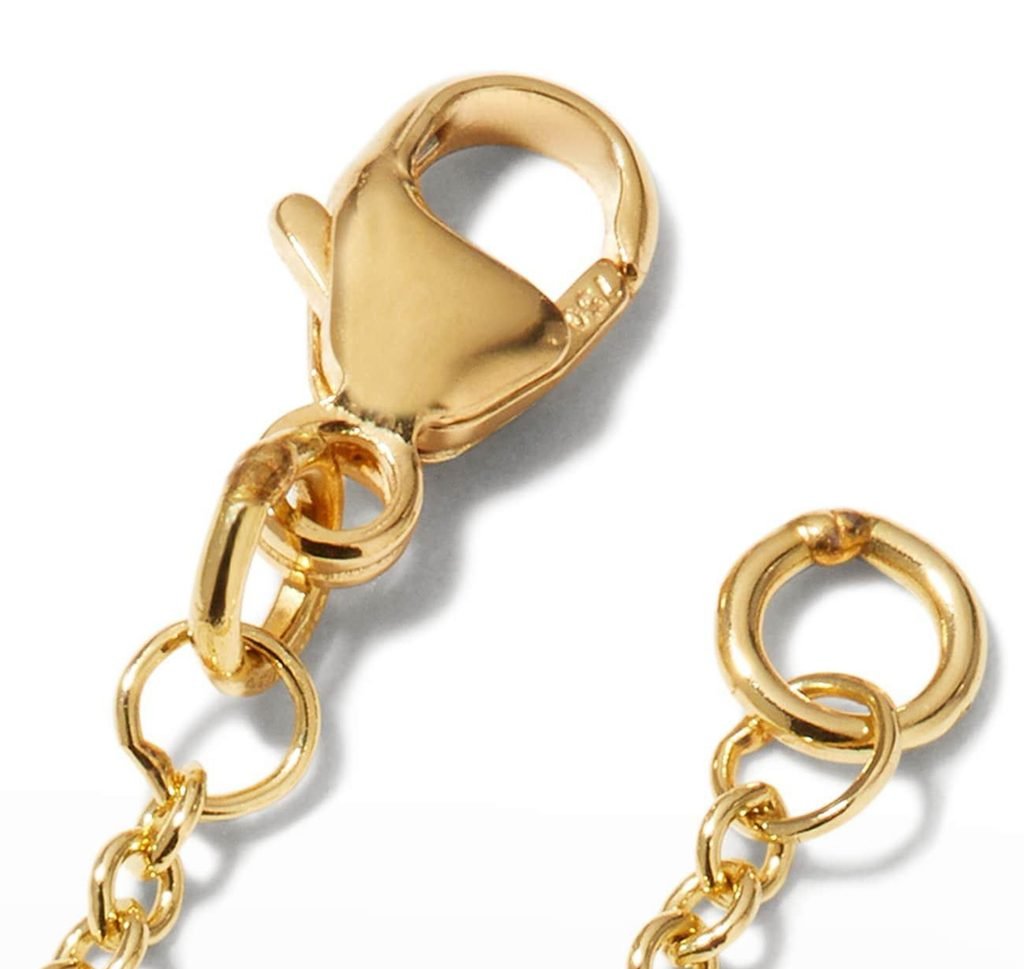
A lobster clasp uses a spring-operated lever to open and close its moving jaw. It connects to a jump ring or chain link and is widely used in necklaces and bracelets.
9. Spring Ring Clasp
A spring ring clasp is a circular fastening with a small spring-loaded opening. Pulling its lever opens the ring; releasing it allows the opening to close.
10. End Cap or Bead Stopper
End caps are used to finish the ends of cords, strands and selected beaded jewellery constructions. Bead stoppers and related components help secure or position beads, depending on the design.
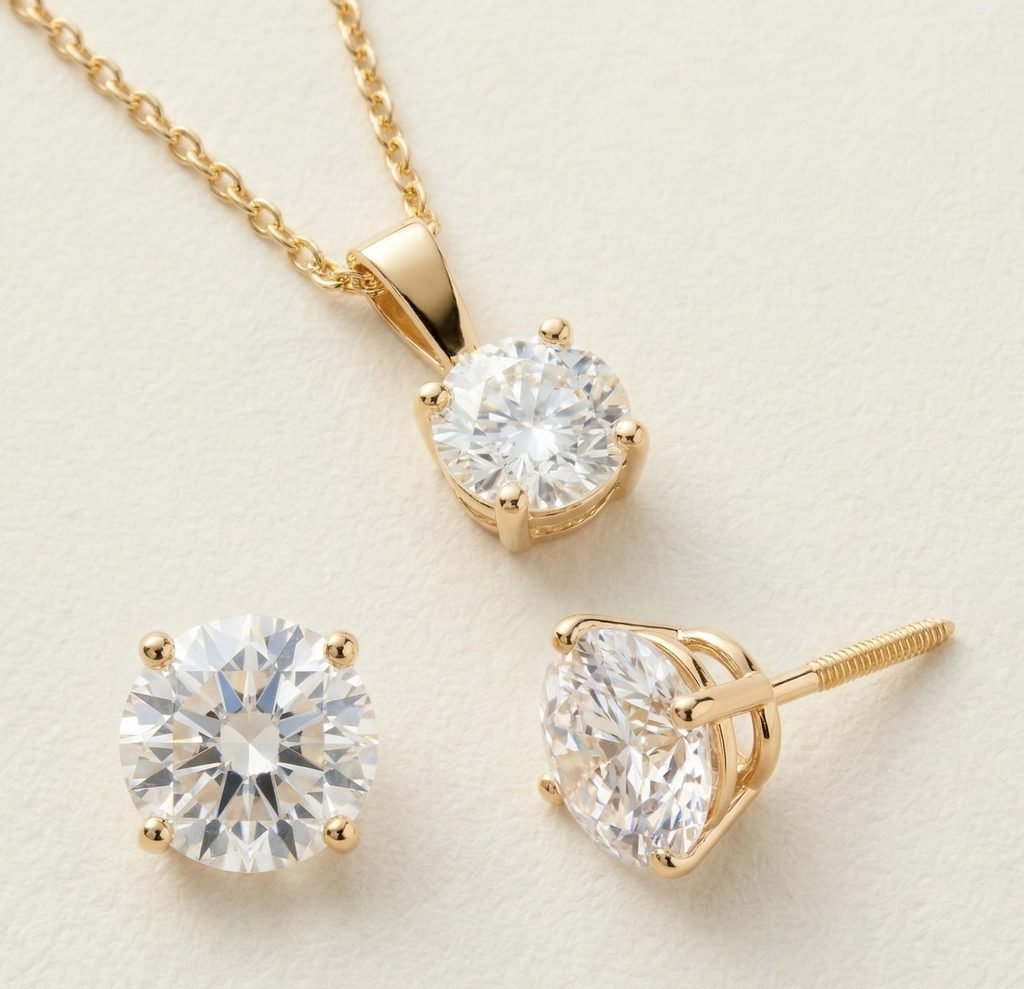
11. Pendant Bail
A pendant bail is a fitting that connects a pendant or charm to a chain. It allows the pendant to hang correctly and may be designed as a visible decorative element.
12. Earring Post with Back
An earring post is a straight pin attached to an earring, while the backing holds it securely in place. This arrangement is commonly used in stud earrings.
13. Pin
A jewellery pin is a connecting or structural component used in certain jewellery assemblies. Its exact form and purpose depend on the design.
14. Earring Back
An earring back is a small fitting that secures an earring post behind the ear. Different designs are available, including push backs and other locking styles.
3. Why Are Jewellery Findings Important?
Jewellery findings are not simply accessories. They perform several important functions.
Security: Properly selected and assembled findings help keep jewellery connected during use.
Ease of use: Clasps should be practical to open and close while remaining secure.
Design flexibility: Different findings allow designers to create a variety of jewellery styles and constructions.
Durability: Appropriate materials and construction help findings withstand repeated use.
Professional finishing: Well-selected components contribute to the appearance and quality of finished jewellery.
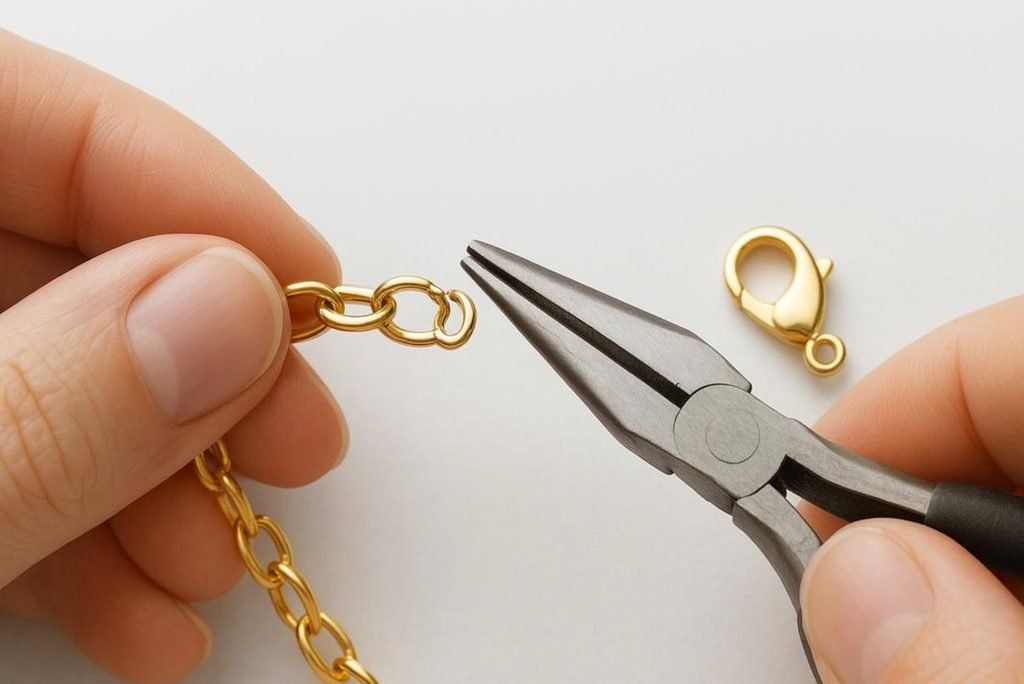
4. How to Assemble a Necklace Using a Lobster Clasp
One of the most common jewellery assembly examples is connecting a lobster clasp to a chain using a jump ring.
Step 1: Prepare the components
Keep the chain, lobster clasp and correctly sized jump ring ready. Check that the components are compatible with the chain and intended design.
Step 2: Attach the jump ring
Use suitable jewellery pliers to open the jump ring by twisting its ends sideways in opposite directions. Avoid pulling the ends directly apart, as this can distort the ring.
Step 3: Connect the clasp
Pass the open jump ring through the end link of the chain and the attachment loop of the lobster clasp.
Step 4: Close the jump ring
Twist the ends back into alignment using pliers. Ensure that the joint is properly closed and that the clasp moves freely.
Step 5: Inspect the assembly
Check the connection, clasp movement and alignment. The finished necklace should open and close smoothly without an exposed gap in the jump ring.
Professional note: The correct jump-ring size, wire thickness and closure method depend on the jewellery design, material and expected load.
5. Common Jewellery Assembly Combinations
| Jewellery application | Common component combination |
|---|---|
| Necklace | Chain + jump ring + lobster clasp |
| Bracelet | Chain + jump ring + toggle clasp |
| Cord jewellery | Cord + end cap + suitable clasp |
| Pendant necklace | Chain + pendant bail + pendant |
| Stud earrings | Earring post + earring back |
These are common examples rather than fixed rules. Jewellery designers select findings according to the design, materials, construction and intended use.
6. What Should Jewellery Manufacturers and Designers Consider?
Choosing the right finding is an important part of jewellery development.
Consider the following:
- Material compatibility: Ensure the finding is suitable for the metal, chain or cord being used.
- Size and proportion: The clasp should match the weight and visual scale of the jewellery.
- Strength: Select a fastening appropriate to the intended application.
- Comfort: Avoid sharp edges or components that may irritate the wearer.
- Ease of operation: Consider how easily the customer can open and close the clasp.
- Finishing: Check surface quality, alignment and consistency with the rest of the jewellery.
The actual metal composition and purity of a gold-coloured finding should always be confirmed through supplier documentation or appropriate testing, not visual appearance alone.
7. The Jewellery Tube – Exploring the Details Behind Jewellery
At The Jewellery Tube, we believe that every part of jewellery has a story worth understanding.
A beautiful jewellery creation is the result of many connected processes: design, material selection, gemstone setting, manufacturing, assembly and finishing.
Jewellery clasps and findings may be small, but they are essential to the final result. Understanding their types and applications helps jewellery professionals appreciate the engineering and craftsmanship behind every finished piece.
Small Components, Big Importance in Jewellery!
Follow The Jewellery Tube for more educational stories about jewellery manufacturing, design, gemstones, craftsmanship and the global jewellery industry.



 English (UK)
 English (United States)